
From Concept to Course Design
How, and why, I built "Technologies of the Word" backwards


Last week, I introduced a new course that I’m teaching about the impact of communication technologies on the history of thought at Université Mohammed VI-Polytechnique. This week, I want to discuss the design of the course to help you think about student-centered course design and the idea of alignment. In other words, I want to take you through my process of moving from concept to course design.
Getting Started with Course Design
While I do think the question concerning technology today is an inherently interesting one that warrants our attention, in designing courses it is important not to be overly seduced by the material itself. This “content-centered” approach to curriculum design is the traditional default for most university courses in most disciplines. Faculty are experts and have dedicated their lives to their subject matter. Accordingly, they often see their responsibility as being to the subject matter itself, and privilege it over everything else. There are good reasons why this has been the tradition of course design.
However, there is an important danger: content-centered approaches often end up being “teacher-centered approaches.” The instructor pursues the questions and the interests that are preoccupying them at the moment they are designing the course. To be sure, these questions and interests have been disciplined through the process of their training and professionalization; they are not arbitrary. But, it is only their individual judgement that becomes the criteria of course development. There is no equivalent of peer-review for teaching as their is for research and no incentive in the modern university to improve the quality of courses. As a result, the college classroom, in North America at least, is by design an “amateur hour.”1 And professors can end up just entertaining themselves. I have started to call this the veil of expertise.
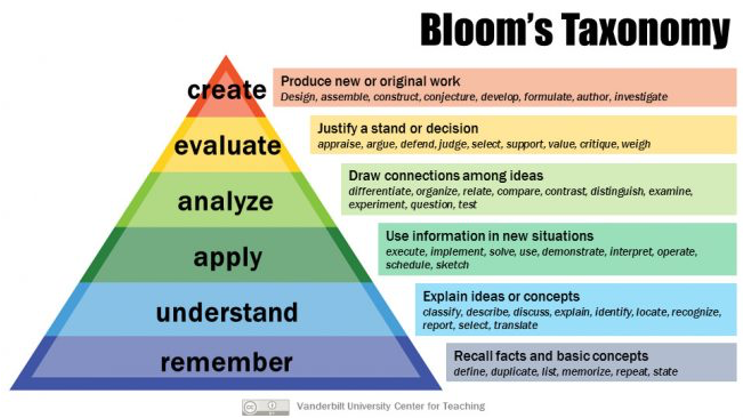
Instead, I began the design process this semester by asking what I want students to be able to do. This is what is known as a learner/student-centered approach to course design. I crafted learning objectives based on a mix of Bloom’s Taxonomy of Educational Objectives (I’ve written about this here) and SMART goal setting (both of which I learned from higher ed teaching and learning consultant Catherine Clepper at P3 Collaboratory for Pedagogy, Professional Development, and Publicly-Engaged Scholarship at Rutgers University-Newark).2 Here is what I came up with:
Learning Objectives
By the end of this course, you will be able to:
Describe the basic characteristics of orality and of communication technologies, including writing, print, digital media, and generative AI.
Explain how communication technologies shape thinking, memory, knowledge, transmission, authority, and affect.
Compare the affordances and constraints of communication technologies using examples from Africa and beyond.
Apply historical perspectives and conceptual tools from African humanities to analyze and situate generative AI as an emergent technology of the word.
Synthesize course concepts to account for how communication technologies shape knowledge in your own situated context and to develop a reasoned practice of technological use.
You will notice that these objectives are sequenced in so far as the first objective reflects a "lower-order” cognitive skill and the last objective is a “higher-order” one. Moreover, they are accumulative in the sense that it would be impossible to “apply historical perspectives and conceptual tools from African humanities” if one cannot “describe the basic characteristics of orality and communication technologies.”
“Assessment is Learning Made Visible”
Staying true to the backwards-design process, the summative assessment was the next course element I worked on.
Admittedly, assessment is the area that I am working to improve upon the most. Even before the pandemic and the tsunami of generative AI, I was a grading skeptic. I’ve felt ambivalent about what assignments actually do. Moving from an Ivy league school to a working-class anchor institution in the Black and Brown city of Newark made me question the assumption that I held that “every course I teach is a writing course.” That difference showed me that I was often grading how much time had previously been poured into a student’s writing, and not at all intelligence, effort, or what students learned. Then, the perfect storm of pandemic and epistemic disruption of AI made the house of cards that is the American grading system come tumbling down.
Still, I have come to a more subtle position. I do find the statement “assessment is learning made visible” compelling.3 It’s a way of keeping ourselves honest as instructors and holding a standard that can produce positive stress and stretch for students. Assessments become particularly important when we distinguish formative assessments and summative assessments. Formative assessments are low-stakes learning activities that provide students opportunities for deliberate practice and feedback for their ongoing performance. Summative assessments are more backwards-looking evaluations of students have learned, and are more likely tied to a grade.
The artful deployment of formative and summative assessment can make all the difference in the success of a course. They mediate not only the content of a course but also the attitudes and affects, ideas and experiences, skills and aspirations of student and instructor alike. In short, its where the course happens.
Because the learning objectives are cumulative, I asked myself what summative assessment would make visible the fact that students synthesized course concepts to account for how communication technologies shape knowledge in their own situated context and that they developed a reasoned practice of technological use. I came up with a “statement of intention” for which students will draft and submit in the final session a reflection paper in which they respond to the question: How do you intend to engage with generative AI in your professional and personal life?
I am fully aware of the probability that students will use AI at some stage of this assignment. And I do not intend to police that. In that way, I see the assignment as being neither AI-resistant nor AI-inclusive, but AI-aware all the same. I will use a rubric that that will favor personalization so that even if they choose to use AI, success will require thoughtful engagement with the question.
Moreover, by the end of the course, with the experience of the classroom activities, our discussions and the formative assessments its my hope to, at the very least, introduce moments of hesitation and friction where thinking will have to happen. For example, for the second session, the one-point assessment for the module on “writing as a technology of the word,” I asked students to free-write without submitting on the question “how does writing transform knowledge.” The lesson itself tracked the historical development of writing and the “cognitive breaks of the reading brain” and used Plato’s Phaedrus, Walter Ong’s Orality and Literacy, and Maryanne Wolf’s Proust and the Squid. They then had to record their conversation with a partner where they explained their answer, and submit that recording. Meanwhile, their partner, with a feedback worksheet listened to determine if the explanation was clear, accurate, and precise. Both the recordings and the feedback were submitted for completion credit.
N.B. - Well-designed and implemented assessments are as much evaluations of teaching effectiveness as they are evaluations of student performance.
Course Structure
Knowing that we will end up of in the eighth three-hour session with the summative assessment, I then started looking at how to organize content at the course and module level. Because there are only eight sessions, I had to be very focused on the essentials. But because they are relatively long sessions, I am able to go to an adequate depth to make sure we actually do what we intend in those sessions. Here are the modules I came up with:
Course Modules
The Orality of Verbal Art
Writing as a Technology of the Word
Print, Reproducibility, and the Standardized Word
Speech, Script, and Print in the Islamic Tradition
The Database as Writing at Scale
Writing for Machines: Algorithmic Thinking and the Word
Generative AI and the Automated Word
Synthesis and Statement of Intention
Notice that there is no pretension here of coverage of a field, let alone comprehensiveness of the issues at play. Moreover, each module is construed as only an introduction to a problem and not an exhaustive survey. The hope is that the course gets them curious about the questions. With this in mind, each session is organized as follows:
Module Format
Activity
Lecture
Formative Assessment
Instead of foregrounding a reading or some other content, I ask myself for each module, what emotionally significant experience will help students understand both the information being conveyed but more importantly why it matters.
For example, in the first module on orality, I started class with a 15-min performance of the West African Akan folk tale about Anansi the Spider and the origins of stories. After a think-pair-share session, I then read a several page passage from On the Origin of Stories: Evolution, Cognition, and Fiction, on the cognitive science of narrative. Interestingly, students were able to recall all the characters, the plot, and several lessons from the Anansi story. In contrast, students were not able to recall by themselves almost any detail from the written passage. They were fully intimated by the language, density, and detail of the prose. But when paired, they were able to reconstruct a point or two. Then, the class as a whole managed to more or less recreate the outline of the whole thing. The lecture then gave them background, context, and concepts to understand these differences before they completed the assessment I described in the previous session.
Course Resources
“Content” came last in this process. While I did have a few references in mind, for example I knew Walter J. Ong’s Orality and Literacy: Technologizing the Word would be a key reference of the arc of the course (it inspired the course title, I did not think of student readings until this step. I’m still working on this, but here are the core texts I’ve identified so far:
Walter J. Ong’s Orality and Literacy: Technologizing the Word, 1982
Plato’s Phaedrus
Wolf, Maryanne. Proust and the squid: The story and science of the reading brain. New York: HarperPerennial, 2007.
Finnegan, Ruth. The oral and beyond: doing things with words in Africa. James Currey/University of Chicago Press, 2007.
Jean-Francois Lyotard, The Postmodern Condition: A Report on Knowledge
Messick, Brinkley. The calligraphic state: Textual domination and history in a Muslim society. Univ of California Press, 1993.
Alignment
This post is probably already too long, so let me end with what I take to be the core principle of this design process: alignment. You start with the end in mind and work backwards, cutting ruthlessly what does not help students do the work you are asking of them, while remaining open to revising those ends when the process reveals something you had not yet considered.
Under conditions of scale, institutional constraint, and accelerating technological change, alignment exceeds the status of a technique. It offers a way of resisting the veil of expertise, the temptation to mistake our interests, fluency, or authority for learning itself. Well-aligned courses create moments of hesitation and friction where thinking has to happen, moments in which students encounter information together with the reasons it matters. From this perspective, alignment begins to look like a form of responsibility, one that remains attentive to students, to knowledge, and to the present in which we are teaching.
Zimmerman, Jonathan. The amateur hour: A history of college teaching in America. Johns Hopkins University Press, 2020.
Usually, I’m more of a Fink’s Taxonomy of Significant Learning kind of guy as it is a much more holistic system. But, admittedly, I think Bloom is “easier” to implement, especially at scale. It also requires that you be in the right place mentally, if not “spiritually” to do it well. And this semester I have 72 students, double the number I’m used to in a totally new context. So, I’m playing it safe. Fink, L. Dee. Creating significant learning experiences: An integrated approach to designing college courses. John Wiley & Sons, 2013.
Ambrose, Susan A., Michael W. Bridges, Michele DiPietro, Marsha C. Lovett, and Marie K. Norman. How learning works: Seven research-based principles for smart teaching. John Wiley & Sons, 2010.