
Making African Humanities Work
From Critique to Curriculum Design

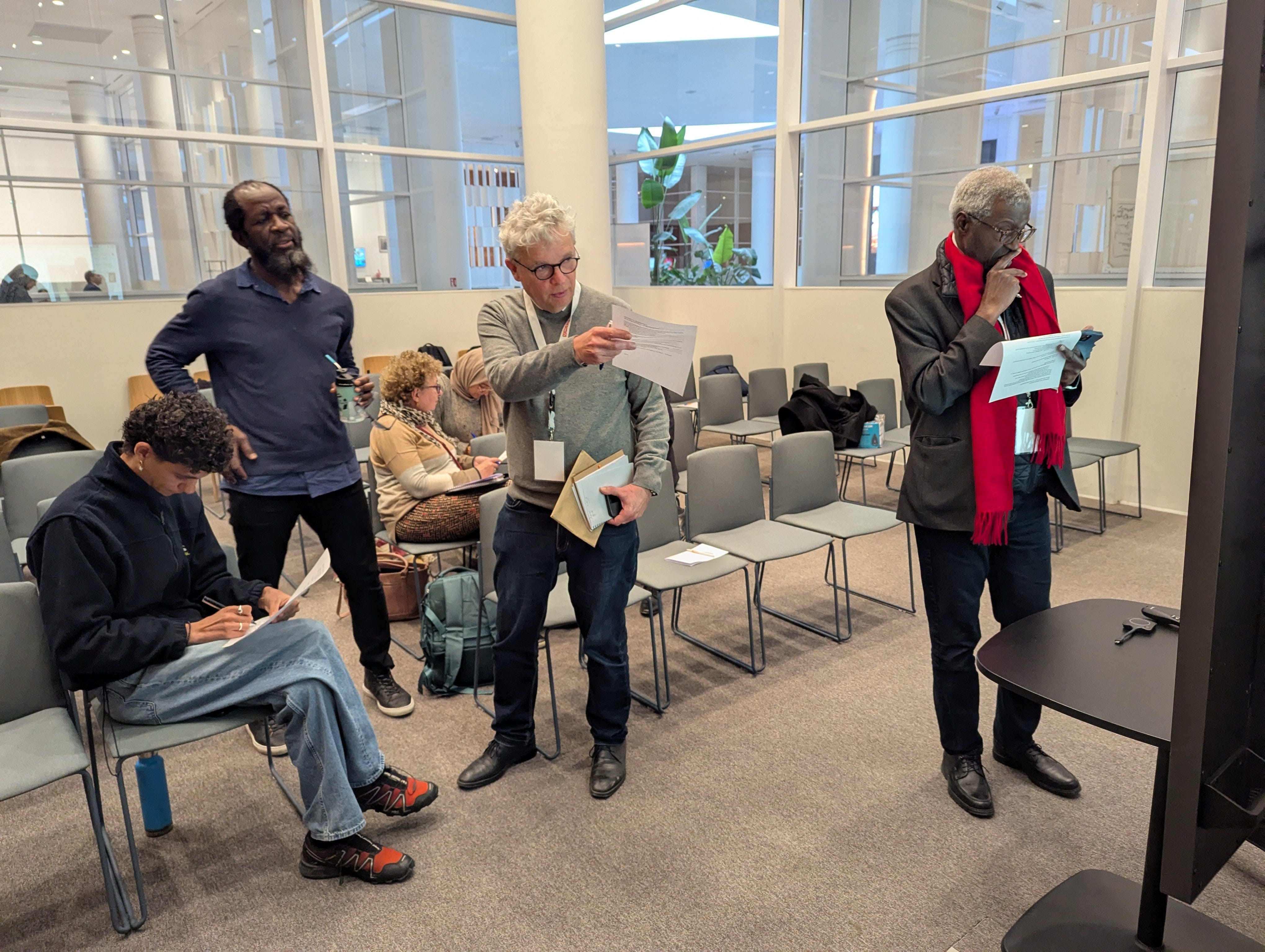
You might not expect an engineering school with state of the art laboratories to be the site of an emergent home of African humanities. But the second edition of the African Humanities Project Workshop hosted last week by the Center for African Studies at Mohammed VI Polytechnic University (UM6P) demonstrated that it just might be.
Institutional partners from Columbia University’s Institute of African Studies and the Department of Philosophy at the Sorbonne and other colleagues from California and Nigeria joined us to consolidate a process we began last year to develop an African humanities curriculum. The ultimate goal though is to pursue, in the words of the Caribbean thinker Aimé Césaire, a humanism made to the measure of the world.
I want to offer here some brief and hurried reflections from the three-day workshop.
Form, Practice, Theory
The plan for our first workshop (December 2024, at UM6P described in last week’s post) was to interrogate history, geography, and the politics of knowledge in order to offer a critique of European exceptionalism and the marginalization of Africa in dominant representations of the human. In practice, our discussions reached further, touching on diasporic connections, language, aesthetics, object-oriented approaches, justice, and pedagogy. The workshop exceeded its original brief, suggesting that our project is best understood as an iterative process of discovery.
As we began to plan the second workshop over the summer, CAS director Ali Benmakhlouf, historian Mamadou Diouf, and Philosopher Souleymane Bachir Diagne, and historian Jinny Prias identified three areas needing our attention: 1) Shaping New Categories, 2) African Humanities and Global Humanist Discourse, and 3) and Language, Translation, and Archives. These themes remain central concerns of our collective work. But as our conversations sharpened in focus we began to shift from the “stuff” of African humanities to its processes, integrating the unanticipated departures from the first workshop.
The heading “Form, Practice, Theory” enabled us to explore how new categories are formed, how African thought engages other humanisms, and how language and archives shape our practice—all while opening space to experiment with how we might do African humanities.
Reference to Afro-Caribbean theorist Sylvia Wynter was important here. In her 2003 essay “Unsettling the Coloniality of Being/Power/Truth/Freedom,” Wynter argues that the re-making of the human requires not only new concepts but also new practices of representation—new ways of telling, showing, and sensing.
The workshop took up that challenge with these questions in mind:
How do engagements with objects—material, textual, sonic, visual, performative, etc.—generate new theoretical departures?
How do we take the form of our scholarly production seriously, whether through graphic novels, creative practice, or other experimental media?
How do practices across disciplines reshape our understanding of knowledge, justice, and humanity?
By centering these questions, Workshop II advanced the project: moving from critique toward practice, from conceptual framing toward methodological and pedagogical innovation.
The Prevalence of Poetry
There were many fantastic presentations, to which I cannot do justice here. I just want to make an observation about the unexpected prevalence of poetry in the workshop. None of the papers took up poetry as such as a topic. And yet, it showed up repeatedly. For Mamadou Diouf who, connecting the likes of the Senegalese author and filmmaker Ousmane Sembène and Bengali poet Rabindranath Tagore, it is poetry that is the only way to do history. For literary critic Asad Ahmad, close readings of classical and modern Arabic and Urdu poetry revealed the modern impoverishment of the reading of “waṭan” as nation. For Ousmane Traoré, who recited a Dyula poet from 19th century Ghana, poetry was the proper response to Ahmed’s readings. For feminist scholar Oyèrónkẹ́ Oyěwùmí, the specific forms of expression in African languages are worthy of our attention in their original untranslatability, suggesting that poetry, and its appreciation, might offer important tools in the recovery of modes of African thought
Then again the prevalence of poetry should have been expected, given our interest in form. The intentional composition of sound and sense for effect, after all, is characterized by its rigorous self-awareness as a construction of form. And it is perhaps that oldest art for which that is the case. Furthermore, our desire to generate new modes of thinking, too, bubbles up from the wellspring of poetry. Is not the etymology of poetry none other than the Greek poēsis, the process of creation?
I think, again, of Césaire, and the opening line of his essay “Poetry and Knowledge:” “Poetic knowledge is born in the great silence of scientific knowledge.”1
On “Binding Wood to Wood”
My own contribution was “praxiological” in the sense that it sought to dissolve the distinction between theory and practice, abstraction and empiricism, pure and applied knowledge. My inspiration was a phrase that I first heard in Morocco in 2007 and have never been able to forget: “lier le bois au bois.”
The line comes from in interlingual moment in Cheikh Hamidou Kane’s Ambiguous Adventure that comments upon the classical theme of postcolonial African literature: the conflict between tradition and modernity. In a conversation between a noble father, a Qur’anic teacher, and the principal of a colonial school, the colonial employee jokingly minimizes his school’s activity when asked the axiological question of its new good by the Qur’anic teacher. He makes a well-known pun on the word l’école (school in French) given its status as a homonym with lekkol, which means “wood” in Pulaar. The character says that they only teach how to “bind wood to wood.”
This passage is often read reflecting the emergence as a new understanding of knowledge in the late colonial period that was amoral, that viewed what happened at school as merely a technical operation. In this reading both “Africa” and “Islam” fall on the side of tradition, and “science” gets encoded as modernity.
But I argued that we should actually read the novel as a cautionary tale about what happens when tradition gets divorced from the questions concerning technology. And in a time when “the humanities” appear on the side of tradition in the face of a hegemonic techno-science, we humanists should not shy away from the problem of “applied knowledge.” This is especially true for contexts of hyper scarcity where the satisfaction of human needs spurs urgent action.
This paper allowed me to justify my insistence on “flipping” the standard academic conference from a space where you present fairly polished individual work to an occasion to work collaboratively. This brings me to what was, for me, the highlight of the event: the Curriculum Design Studio (CDS).
Curriculum Design Studio
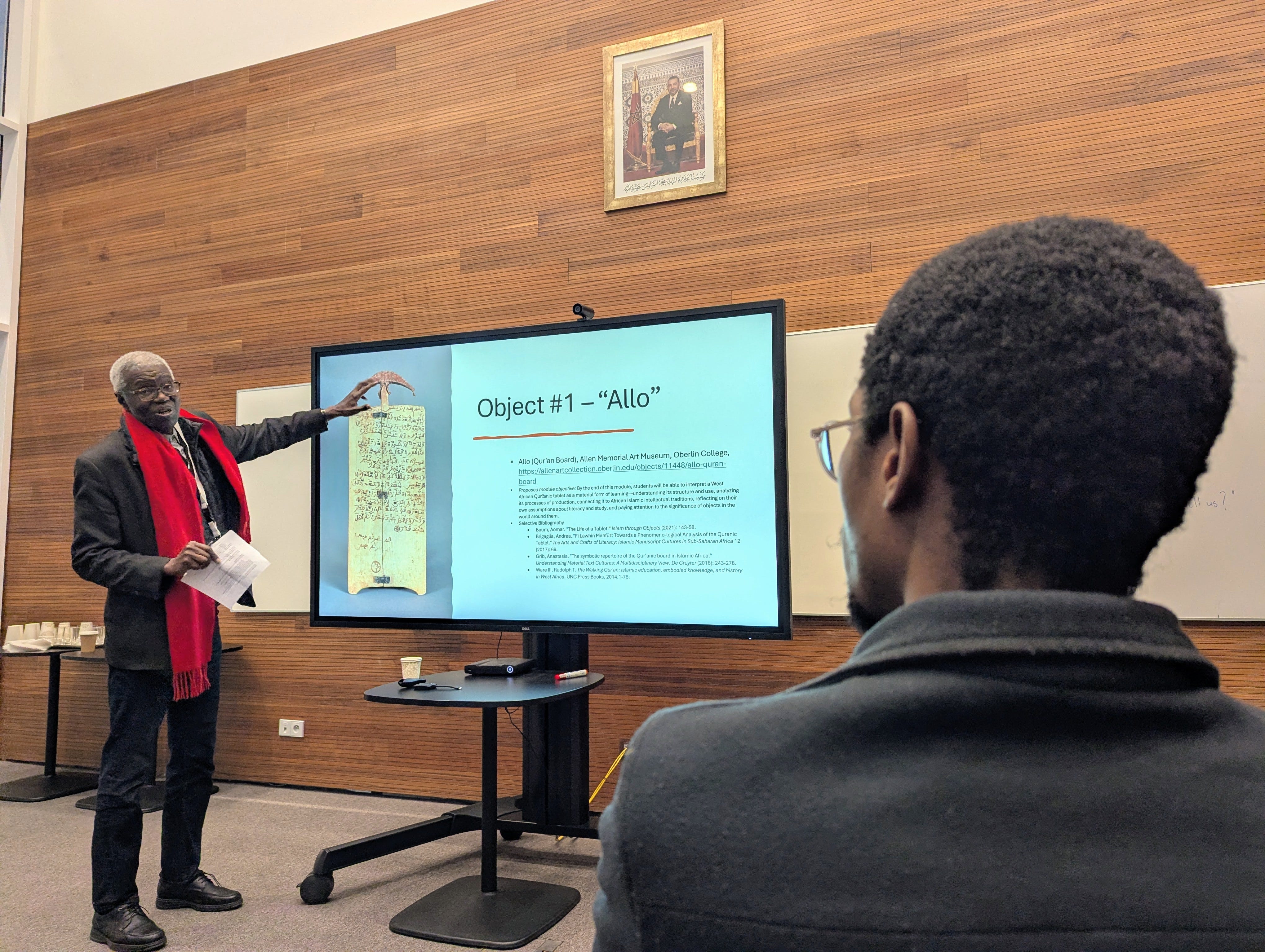
The final day of the workshop consisted of hands-on activities dedicated to making progress on developing curricula for an object-oriented African Humanities. Our goal was to quickly prototype a lean learning module for a hypothetical Massive Online Open Course in African Humanities using two meaningful “objects” from African settings.
During last year’s workshop, the object-orientation to the humanities emerged as a viable strategy to avoid the Eurocentrism of classical humanities, engage histories of violence tied to slavery and colonialism in a trauma-informed way, and teach transferable skills of description and interpretation. Laurent Jaffro’s aesthetic definition of the humanities as the “cultivation of sensitivity towards the qualities of objects” was particularly useful. For our purposes in the studio, I defined an “object” as any article that is subjected to human sensory perception, such as a text, a painting, an item used for ritual purposes, quotidian ephemera, etc. The object is never given but is made by our attention devoted to it.
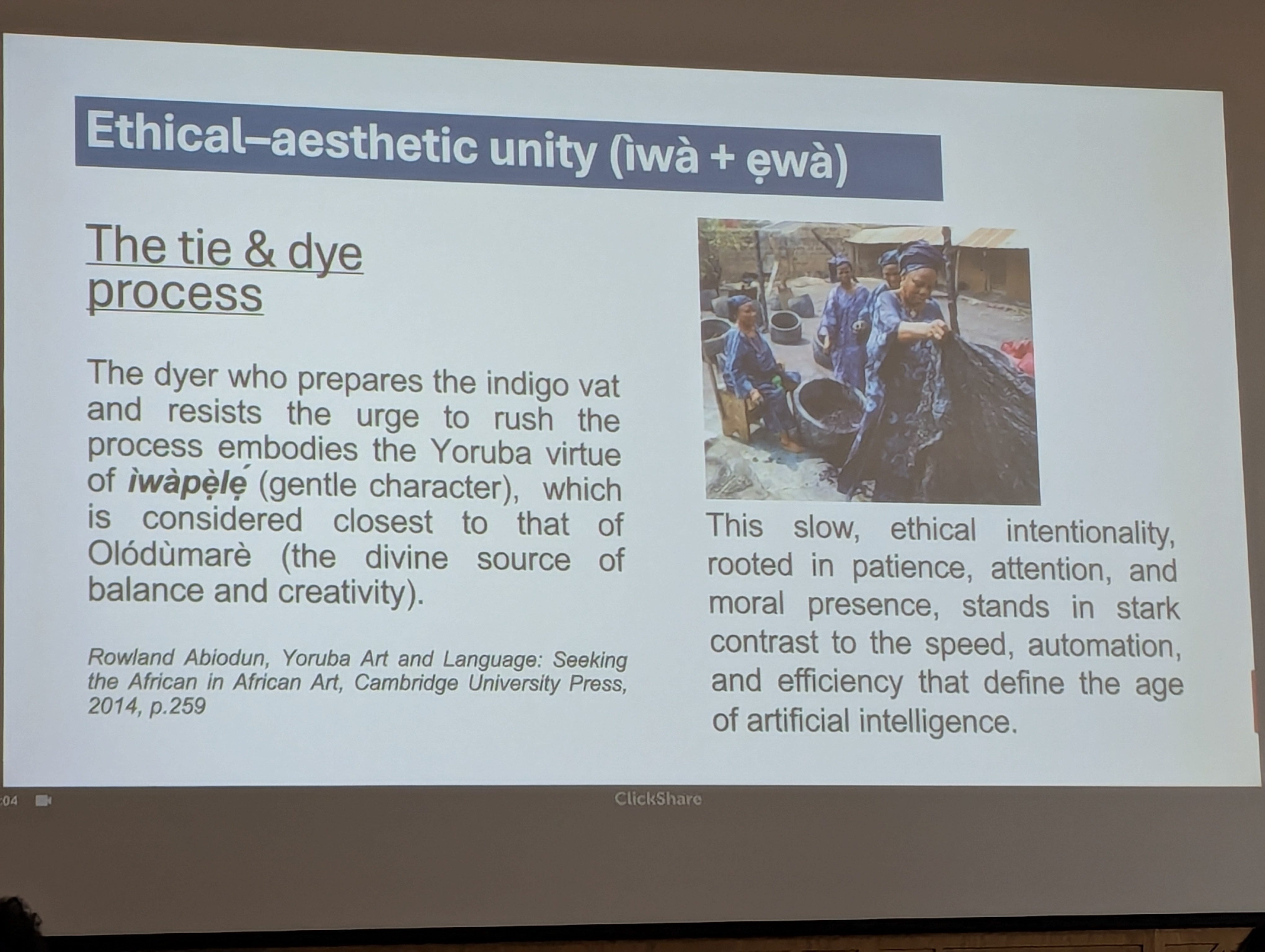
Participants were given a learning objective, an object, and some resources around which to plan an aligned learning module with activities and assessments. The objects were a wooden Qur’anic tablet and an Àdìrẹ “tie-and-dye” cloth, both produced in Nigeria but housed in museums elsewhere.
I must say that the CDS provided me with what might be one of the proudest moments of my career to date: I got the chance to “teach” my teachers. Historian Mamadou Diouf and Philosopher Souleymane Bachir Diagne were amazing participants who helped demonstrate the proof-of-concept of both the object-oriented learning module and for the promise of getting humanities scholars to work collaboratively in real time, and not just talk to each other.
With this success, I am now more certain than ever of the potential for projects such as the Curriculum Design Studio to make African humanities work.
Aimé Césaire, Lyric and dramatic poetry, 1946-82. University of Virginia Press, 1990, xlii.